Microservices: Ultimate Architectural Guide with Pro Strategies (2025 Edition)
Microservices represent a transformative architectural approach, revolutionizing how modern software systems are built and scaled. In today’s fast-paced digital landscape, businesses demand applications that are agile, resilient, and easily scalable. Microservices deliver exactly that by breaking down monolithic systems into independently deployable, loosely coupled services.

Microservices represent a transformative architectural approach, revolutionizing how modern software systems are built and scaled. In today’s fast-paced digital landscape, businesses demand applications that are agile, resilient, and easily scalable. Microservices deliver exactly that by breaking down monolithic systems into independently deployable, loosely coupled services.
Microservices: Ultimate Architectural Guide with Pro Strategies
I still remember the first time I heard the term "Service-Oriented Architecture" (SOA) back in the late 2000s. We thought it was the silver bullet to fix our massive, tangled legacy systems. But SOA often just led to heavy, slow Enterprise Service Buses that became the new bottlenecks.
Microservices are the evolution of those hard lessons. They represent a transformative architectural approach, revolutionizing how modern software systems are built, scaled, and maintained. In today’s digital landscape, you cannot afford a deployment that takes the whole system offline. You need applications that are agile, resilient, and scale dynamically.
By breaking down monolithic systems into independently deployable, loosely coupled services, you adapt faster to market needs, deploy continuously, and adopt new tools without rewriting the world.
Key Benefits of Microservices
This isn’t just an industry buzzword; the ROI is tangible if executed correctly:
Agility: Small, autonomous teams own specific services. This enables rapid feature development and decoupled, independent deployments.
Scalability: If your billing system is under heavy load, you scale only the billing pods, optimizing compute resources and cloud costs.
Technology Diversity: Teams can embrace polyglot programming. You can use the best tool for the job rather than forcing a one-size-fits-all language.
1. Building Microservices from Scratch: The Blueprint
Crafting a distributed application from the ground up is a rewarding challenge, but it requires extreme discipline before you write your first line of code.
Defining Service Boundaries
If you slice your services wrong, you will create a "distributed monolith" that is infinitely harder to manage. This is where Domain-Driven Design (DDD) is mandatory. You must model your business domains as "bounded contexts" to ensure each service owns a specific business capability.
For example, in an e-commerce platform:
Order Management: Handles the lifecycle of a cart to a finalized order.
Inventory: Tracks physical stock in warehouses.
User Profiles: Manages authentication and user preferences.
Pro Strategies:
Analyze actual business workflows, not just database tables, to identify cohesive units.
Engage non-technical stakeholders to validate your domain models.
Avoid over-segmentation. If two services constantly share exactly the same data to function, they probably belong in the same service.
Choosing Tech Stack and Languages
Microservices thrive on flexibility. You might use Node.js for a lightweight, high-throughput BFF (Backend for Frontend), Python for an AI-integration worker, and Go for an intensive core API.
Factors to consider:
Team Expertise: Don't pick Rust if your entire team only knows JavaScript.
Ecosystem Maturity: Look for robust libraries (like Prisma for ORM in the Node world) and strong community support.
Operational Simplicity: Ensure your CI/CD pipelines can easily handle building and testing the chosen languages.
Structuring Your Microservice Codebase
How you organize your Git repositories defines your developer experience:
Monorepo vs. Polyrepo: A monorepo (all services in one Git repository) makes sharing types and managing cross-cutting PRs much easier, especially for smaller teams. A polyrepo (one repo per service) enforces strict boundaries but requires sophisticated tooling to manage.
Shared Libraries: Use them sparingly. Sharing a logging utility is fine; sharing core domain logic creates tight, dangerous coupling.
2. The Nightmare of Data Consistency (Sagas & Event Sourcing)
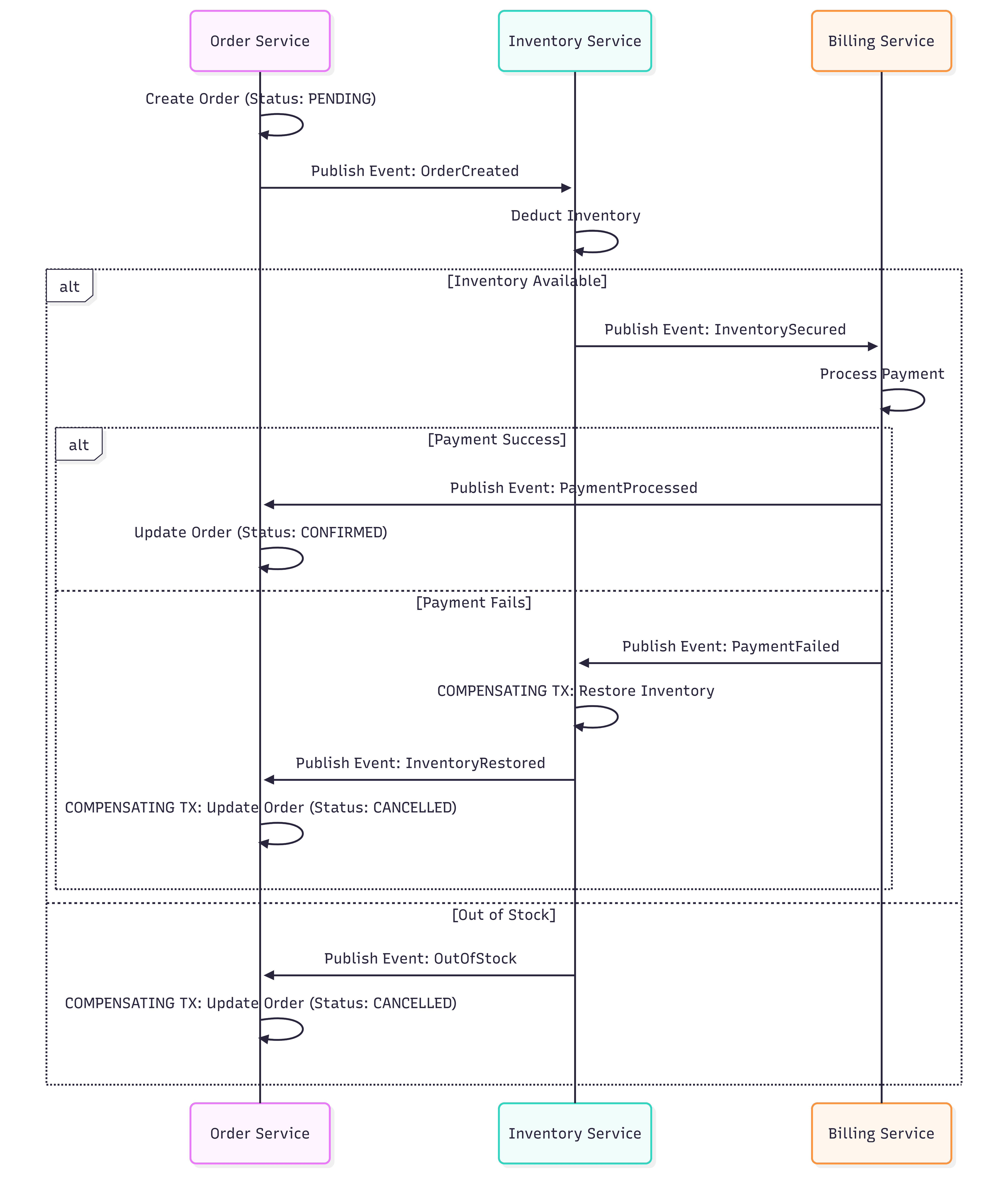
Here is the hardest truth about microservices: managing state across distributed databases is a nightmare. In a monolith, you rely on ACID transactions. If a user places an order, you deduct inventory and charge the card in a single SQL transaction. If the card declines, the database simply ROLLBACKs the inventory deduction.
In a microservices architecture, the OrderService, InventoryService, and BillingService all have their own isolated databases. You cannot run a distributed SQL JOIN or a cross-service transaction without locking tables and destroying your scalability (a pattern known as Two-Phase Commit, or 2PC, which you should avoid at all costs).
So, what happens if the Order is created, the Inventory is deducted, but the Billing service fails?
The Solution: The Saga Pattern A Saga is a sequence of local transactions. Each service updates its own database and publishes an event to trigger the next step. Crucially, if a step fails, the Saga executes compensating transactions to undo the previous steps.
Pro Strategy: Event Sourcing. For hyper-critical financial or ledger data, don't just store the current state in a database row. Store every state change as an immutable sequence of events in an event store (like Kafka or EventStoreDB). The current state is derived by replaying the events. This gives you a perfect audit trail and makes debugging complex distributed failures infinitely easier.
3. Service Communication Patterns
Microservices must talk to each other, and your choice of transport dictates the latency and reliability of your system.
HTTP/REST Communication
RESTful APIs are the industry standard. They are stateless, language-agnostic, and easy to debug. They are the best choice for external-facing APIs or standard CRUD internal operations.
Best Practices: Use consistent endpoint naming, rely on standard HTTP status codes for graceful error handling, and always implement versioning (e.g.,
/api/v1/orders) to protect clients from breaking changes.
gRPC for High-Performance Communication
When you need low-latency, high-throughput service-to-service communication, REST is too slow. gRPC is built on HTTP/2 and uses Protocol Buffers for incredibly efficient binary serialization.
Ideal Use Cases: Internal data fetching, high-volume real-time streams, and environments where strong type safety and contract-first development are critical.
Asynchronous Messaging with Message Queues
Not everything needs an immediate response. If a user places an order, the system can return a "Success" immediately while background workers handle the heavy lifting.
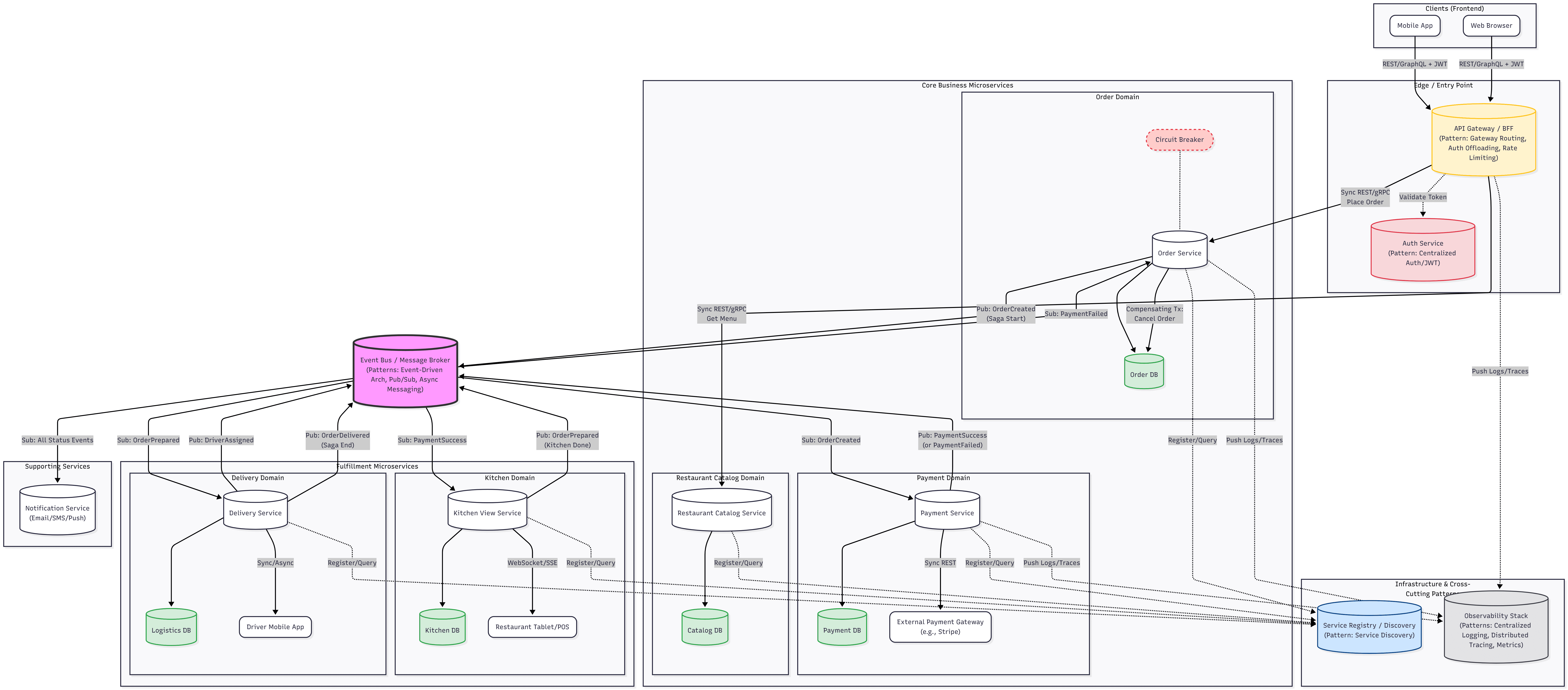
Message Queues (Kafka, RabbitMQ): These decouple services. The Order service publishes an
OrderCreatedevent, and the Inventory and Notification services consume it at their own pace.Pro Tip: Adopt hybrid communication. Use REST/gRPC for synchronous real-time reads, and Message Queues for long-running asynchronous workflows.
Restaurant Order :
4. Containerization and Orchestration
Docker and Kubernetes (K8s) are the industry standards for deploying microservices, but let's cut through the marketing fluff: Kubernetes introduces a massive complexity tax.
Docker solves the "it works on my machine" problem by packaging your service, like a Node.js API or a Python worker, into a lean, isolated container. Kubernetes solves the "how do I run 50 of these across multiple servers without losing my mind" problem. It handles pod replication, self-healing, and service discovery.
Building & Running Microservice Containers
Docker packages your service and its runtime together.
Dockerfile Essentials: Always use multi-stage builds. Compile your code (like running
prisma generateor building a frontend) in one stage, and copy only the compiled artifacts to a lean production image.Service Discovery: Services should locate each other via DNS names (e.g.,
http://billing-service:3000), never hardcoded IP addresses.
Orchestrating Containers with Kubernetes
Running five containers is easy. Running five hundred requires an orchestrator. Kubernetes (K8s) is the operating system for the cloud.
Pods & Deployments: K8s manages your container replicas, scaling them up based on CPU or memory load.
Self-Healing: If a container crashes, K8s instantly restarts it or rolls back to a stable version.
CI/CD Pipelines
Automation is non-negotiable. Using tools like GitHub Actions or GitLab CI, every commit should trigger:
Automated unit and contract tests.
A Docker image build.
A zero-downtime deployment to your Kubernetes cluster.
5. API Gateway Implementations
You cannot expose twenty different microservices directly to the public internet.
Routing Traffic Efficiently
An API Gateway (like Kong, NGINX, or AWS API Gateway) acts as the single front door.
It handles URL mapping, routing
/usersto the User Service and/productsto the Catalog Service.It handles aggregation, compiling data from multiple services into a single response to reduce client-side network round trips.
Load Balancing and Security
Gateways are your first line of defense. They distribute incoming traffic evenly across your service replicas to prevent overload. Furthermore, they offload cross-cutting concerns:
Authentication & Authorization: Validate JWTs or OAuth2 tokens at the gateway before the request ever reaches your internal network.
Rate Limiting: Throttle excessive requests to protect your backend from DDoS attacks or runaway client scripts.
6. Distributed System Challenges
You are trading the in-memory complexity of a monolith for the network complexity of a distributed system. You must plan for chaos.
Fault Tolerance and Recovery
Network calls will fail. Systems must be resilient.
Circuit Breakers: If a downstream service is struggling, trip the circuit to stop sending it traffic. This prevents cascading system failures and gives the service time to recover.
Retry Policies: Implement intelligent retries with exponential backoff for transient network blips.
Monitoring and Observability
If you don't have observability, you are flying blind.
Metrics & Tracing: Use tools like Prometheus for tracking error rates and OpenTelemetry/Jaeger to trace a single request's journey across ten different service boundaries.
Centralized Logging
Never check individual server files. Aggregate all logs into an ELK Stack (Elasticsearch, Logstash, Kibana) or Fluentd.
Pro Strategy: Standardize your logging output to JSON across all services. If you are building Node.js services, drop heavy loggers and switch to Pino. It has significantly lower overhead and outputs clean JSON, making it perfectly optimized for centralized log aggregators to parse and index quickly.
Frequently Asked Questions
1. What is the main advantage of microservices over monolithic architecture? They offer increased agility, scalability, and resilience by decomposing large applications into smaller, independently deployable units, allowing teams to move faster with less friction.
2. When should I use gRPC over HTTP/REST in microservices? Use gRPC for internal, high-performance, and low-latency service-to-service communication. Keep REST for public-facing APIs or when you need broad client compatibility.
3. How do I secure my microservices? Implement your primary authentication and authorization at the API Gateway. Ensure all internal service-to-service communication is encrypted (mTLS), and strictly apply the principle of least privilege for database access.
4. What tools help monitor and debug microservices? You need the "three pillars of observability": Distributed tracing (Jaeger, OpenTelemetry), metrics (Prometheus, Grafana), and centralized structured logging (ELK Stack, Datadog).
5. How can I prevent failures from cascading in a microservices system? Design for failure. Implement circuit breaker patterns, set aggressive and sensible network timeouts, use bulkhead isolation, and utilize asynchronous message queues where immediate responses aren't required.
6. Can I migrate a legacy monolith to microservices incrementally? Absolutely. Use the "Strangler Fig Pattern." Put an API Gateway in front, extract one business domain at a time into a new service, route that specific traffic to the new service, and repeat until the monolith is retired.
Conclusion: Future of Microservices Architecture
Microservices are shaping the future of software delivery—enabling organizations to build complex systems with speed, agility, and reliability. As adoption matures, we are seeing massive advancements in service mesh technology (like Istio), deeper observability, and AI-driven infrastructure orchestration. For teams willing to invest in robust design and automated tooling, microservices offer a definitive pathway to long-term innovation and a serious competitive edge.